


- 26 August, 2026
- 259
- 0
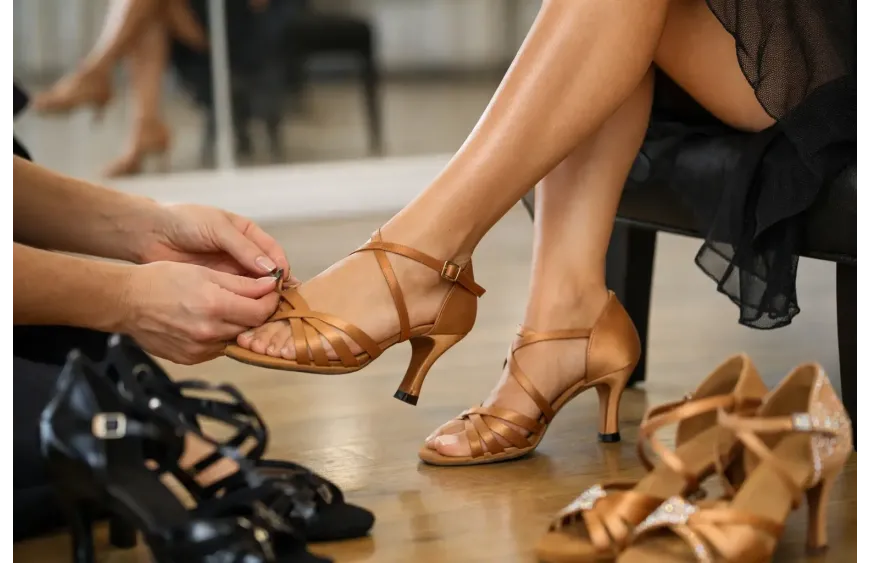
A Latin heel that looks beautiful but lets your foot slide forward will change how you dance. You may grip with your toes, lose stability in turns, or hesitate to use the ball of the foot fully. Knowing how to fit Latin heels means looking beyond the size printed on the sole. The right pair should feel close, secure, and responsive from your first basic step through a full practice or social dance.
Latin shoes are designed differently from everyday heels. Their flexible soles, open toes, narrow profiles, and ankle straps are made to support pointed feet, weight transfers, spins, and fast directional changes. A proper fit should help you feel connected to the floor, not trapped by the shoe.
How to Fit Latin Heels: Start With a Snug Feel
A new Latin heel should fit more snugly than a street shoe, especially if it is made with satin, leather, or a soft synthetic upper that may relax with wear. Snug does not mean painful. Your foot should be held in place without numbness, pinching, burning, or pressure that forces your toes to curl.
The most important area is the ball of the foot. This is where you create pressure into the floor for Latin walks, cha-cha locks, rumba action, and turns. The widest part of your foot should sit over the widest part of the shoe's sole. If your foot hangs over either side, the shoe is too narrow or too small. If you can slide your foot from side to side, it is too wide or too large.
Avoid choosing a shoe simply because it feels roomy in the store. Extra space can feel comfortable while standing still but become a problem once you start moving. A loose shoe allows the foot to travel forward, which can leave the toes exposed over an open-toe sole and make the heel feel unstable.
Check Your Toe Placement
With open-toe Latin heels, your toes should sit close to the front edge of the sole without spilling over it. There should not be a large visible gap in front of your toes, but your toes also should not extend beyond the platform or scrape the floor when you point.
Look at each toe, not just the big toe. If the little toe is pushed outside the straps or hangs over the edge, try a wider fit, a different toe shape, or another style. A shoe can be the correct length and still be wrong for your foot shape.
Closed-toe Latin styles need a little more room at the front, but not enough for the toes to slide during a forward walk. Gently rise onto the balls of your feet. If your toes jam hard against the front, the shoe is too short. If your heel lifts and your foot shifts forward, the shoe lacks security.
The Heel Cup Must Stay With Your Foot
Your heel should sit fully in the heel cup, with the back of the shoe held against your heel as you walk, point, and turn. Small movement can be normal in certain flexible dance shoes, but repeated slipping is not. A heel cup that gaps or lifts makes it difficult to balance and can encourage you to grip the floor with your toes.
Walk on a clean, dry surface before wearing the shoes on the dance floor. Take a few slow forward and backward steps, rise through the feet, and test a controlled pivot. Notice whether your heel stays centered or twists inside the shoe. If it twists, the shoe may be too wide through the back, the strap may need adjustment, or the heel height may be more than you can comfortably control.
Heel height matters, particularly for a first pair. A higher heel can create a longer leg line and more pronounced foot shape, but it also places more demand on the ankles, calves, and balance. A lower or flared heel is often a sensible choice for beginners, social dancers, and anyone returning to dance after time away. More experienced dancers may prefer a slimmer or taller heel, provided they can maintain stable weight placement.
Adjust the Straps for Support, Not Compression
Straps should stabilize the shoe without cutting into the foot. The ankle strap should be firm enough that the heel stays close to your foot, yet loose enough to let you point and flex the ankle naturally. If the strap leaves deep marks immediately or causes tingling, it is too tight.
Cross straps and toe straps should lie flat. Twisted straps can create pressure points that become painful after a few dances. Check that the buckle sits where it will not rub against the ankle bone, and make adjustments while standing in your normal dance posture, not while sitting down.
Many dancers assume they need to pull straps as tight as possible to prevent slipping. Often, that makes matters worse by pushing the foot forward and compressing the toes. If the shoe still feels loose when the straps are adjusted correctly, a smaller size, narrower width, or a different style is likely the better answer.
Test the Fit in Dance Positions
Standing flat-footed only tells part of the story. Latin heels need to perform when the foot is pointed, the knee is soft, and your weight is moving over the ball of the foot. Before committing to a pair, test these positions:
- Rise onto demi-pointe and make sure the foot does not slide forward.
- Point each foot and check that the heel cup and straps remain secure.
- Bend both knees slightly as you would in Latin action, noticing pressure across the toes.
- Take several walks, then make a slow pivot to check your balance and traction.
Pay attention to what happens after a few minutes, not only the first step. A shoe that seems fine at first may reveal rubbing at the little toe, across the instep, or at the back of the heel as the foot warms up.
Size Is a Starting Point, Not a Guarantee
Dance-shoe sizing varies by brand, material, and style. Some Latin heels are labeled in street-shoe sizing, while others are sized differently. An open-toe sandal may also fit differently than a closed-toe practice shoe from the same maker. That is why it is risky to order a familiar size without checking the specific size guidance for the shoe.
Try shoes on later in the day when your feet are closer to their usual danced-in size. Wear the type of hosiery you expect to use, if any. Most Latin dancers wear shoes barefoot or with very thin hosiery, so testing in thick socks will not give an accurate fit.
If one foot is slightly larger, fit the larger foot. It is common, and forcing the larger foot into a too-small shoe will quickly cause problems. A qualified fitting can be especially helpful when you have a bunion, a wide forefoot, a narrow heel, sensitive toes, or a history of ankle discomfort.
Break In Latin Heels Gradually
New dance shoes should be worn in thoughtfully. Do not save a brand-new pair for a long social, showcase, or competition without testing them first. Wear them at home on a clean surface for short intervals, practicing basic walks, weight changes, and gentle turns. This lets the upper settle to your foot while giving you time to identify hot spots.
Do not expect a painful shoe to become comfortable simply because it stretches. Some materials will give slightly across the width, but a shoe that is too short, too narrow in the wrong place, or unstable at the heel will not become a good fit through use. Protecting the suede sole from outdoor surfaces also helps preserve the control and glide that Latin dancing requires.
When a Professional Fitting Makes Sense
A knowledgeable fitting is worthwhile for your first Latin heel, a major change in heel height, or a shoe for regular dancing. In-person guidance can help distinguish a strap adjustment from a genuine sizing issue and compare styles built for different foot shapes. For dancers in Toronto and the GTA, Dancewear Champions offers personal shoe-fitting guidance in Thornhill for dancers who want to move, turn, and test their choices with confidence.
The best Latin heel is not the highest, narrowest, or most decorated pair on the shelf. It is the pair that keeps your foot secure enough to stop thinking about your shoes and start responding to the music.
Tags How to Fit Latin Heels, Latin Heels, dance shoes for women, women dance shoes, i love dance shoes
Related Products
Sale
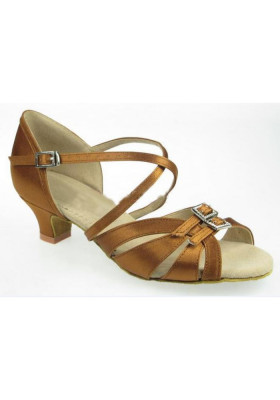
Low Heels Dance Shoes 15 - Heel 1.5
$140.00CAD $75.00CAD

Galex - Emma - Tan-Satin - Heel - Slim 8cm
$238.00CAD
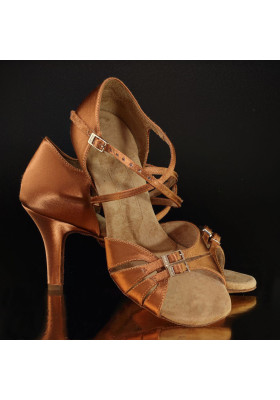


IDS - Flavia Sequin - Black Satin - 3" Heel
$248.00CAD